
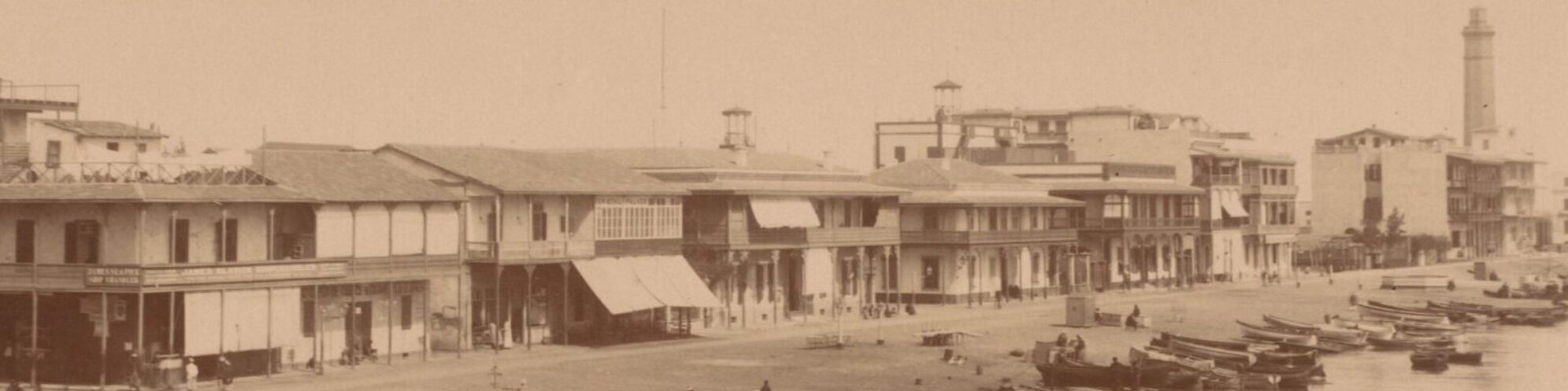
Fighting Pandemics from Below. New Diplomatic Histories of Global North-South Public Health Cooperation
Utrecht University | 30 September – 1 October 2027
Organised by the ERC COOPERATION project , in collaboration with the Quarantine Studies Network
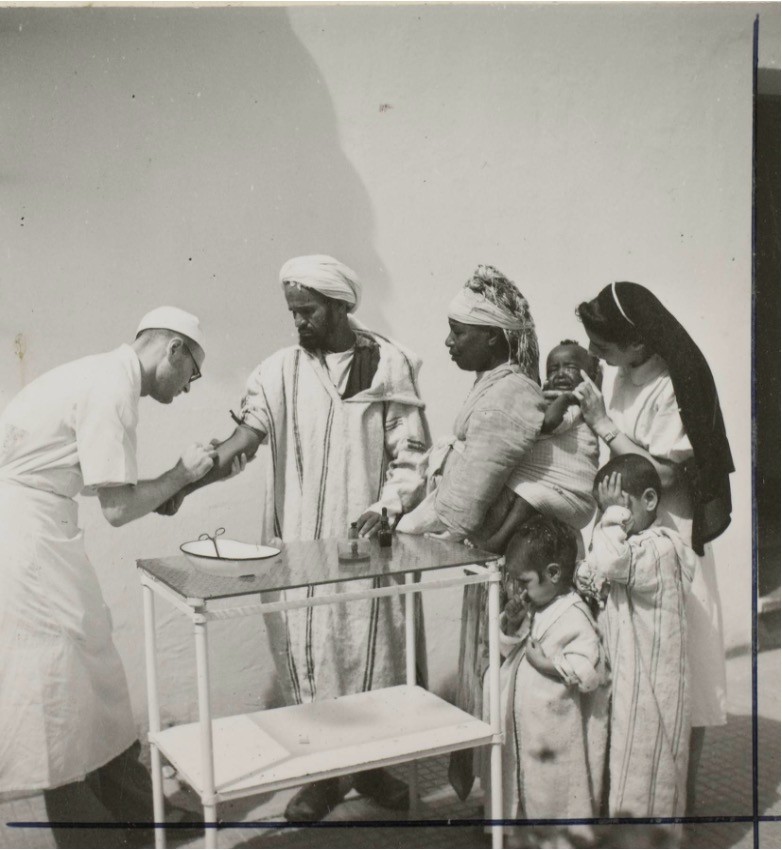
Rabat. Hôpital indigène. Piqûre des Malades, Fonds Jacques Belin, Maroc, Centre des Archives diplomatiques de Nantes, 28 juil. 1942
During the COVID-19 pandemic, the inadequacy of health cooperation between the so-called global north and south had dire and lethal consequences for humanity. The rapid spread of the disease, alarming death rates and governments’ unilateral agendas led to repeated calls from health experts for collaborative action across the globe. Instead, the world has witnessed heightened geopolitical rivalries, reproduction of Orientalist binaries and vaccine inequity that deprioritize health as a global public good. Today, health practitioners and scholars across disciplines agree that building new coordination mechanisms and, by this means, strengthening the capacity of local community groups in lower-income countries is crucial to stamp out communicable diseases. While these appeals are in line with the mantra of humanitarian efforts since the World Humanitarian Summit of 2016, ‘as local as possible, as international as necessary’, there is still limited consensus as to how we can induce and sustain localised sanitary internationalism.
With these pressing issues in mind, we would like to invite historians of diplomacy, medicine, IR, empires, and other related fields to turn to the guidance of the past. The ‘Fighting Pandemics from Below’ international conference will be organized at Utrecht University, the Netherlands, on 30 September – 1 October 2027 by ERC COOPERATION project team with the support of the Quarantine Studies Network. In this conference, we will discuss histories of localised sanitary internationalism with a view to publishing an edited volume.
We define sanitary internationalism as ‘the organised, coordinated efforts of multiple international actors to confront shared health challenges and pursue collective health outcomes across borders.’ Its historiography habitually considers the fourteen international sanitary conferences (ISCs) that were held between 1851 and 1938 as the onset of sanitary internationalism. Yet, as the ERC COOPERATION project team argues, the year 1851, so often recorded as the founding moment, was in practice a moment of rupture. It disrupted a localised global north–south public health cooperation that had already taken root in the international sanitary councils of Tangier, Tunis, Alexandria, and Istanbul. By fighting pandemics from below, rather than relying on high-level intergovernmental gatherings and conventions alone, the councils obtained more concrete results at a time when the ISCs were at a loss.
The conference and the ensuing volume will build upon the postulations of the ERC COOPERATION project. We welcome proposals on the sanitary councils and the histories around them, but equally on similar moments, regimes and institutions of localised sanitary internationalism beyond the Middle East and North Africa (MENA), and in other parts of the world. Rather than drawing on social histories of health alone, we would like to think together on new diplomatic histories of public health, and to ask what the preconditions were for effective or failed international health cooperation from below. We particularly look for abstracts on the long nineteenth century (c. 1780s–1940s), though papers reaching before or after are equally welcome.
Possible themes:
- Health boards and magistrates as forms of institutionalised public health
- Sanitary councils in MENA (esp. Tangier, Tunis, Alexandria, Beirut, Smyrna/Izmir, Istanbul and Tehran) and beyond
- Cities, ports, and hinterlands as transimperial sites of public health cooperation
- The commerce-health nexus
- Sovereignty, legitimacy, and international public health
- Finances of localised sanitary internationalism: taxes and loans
- Transimperial quarantine regimes, institutions and practices
- Urban reform, sanitation, and sanitary imperialism
- Policing movement: pilgrims, passengers, and the control of contagion
- Quarantine experiences
- Women, gender and, the practice of sanitary internationalism
- Epidemiological Orientalism and Occidentalism
- Epizootics, cattle plague and livestock quarantine
- Inter-pandemics and recovery periods for pandemic preparedness
Conference format
This is an in-person event. The conference is conceived as a publication-oriented workshop: participants are required to circulate their papers in advance and engage in in-depth discussion with the work of others over the course of the two days, with a view to contributing a chapter to the edited volume.
Application and deadlines
– An abstract of no more than 350 words and a brief biographical note (max. 150 words)
– Presentation language: English
– Deadline for proposals: 30 November 2026
Notification of acceptance: 18 January 2027
Pre-circulation of papers: Two weeks before the conference
Please send your abstract and short bio in one word document to Dr Yasmine Najm (y.najm@uu.nl) and Bianca Visser (b.visser@uu.nl).
The organisers will cover travel and accommodation for accepted participants, and provide visa invitation letters on request.